new book
The following article comes from the concept of Kan, written by Xiao Kan.
Watch carefully.
Faze the world, books moisten people’s hearts. Welcome to pay attention to the concept! The research and publication information of law and public management will be released here. I look forward to reading a good book with you and seeing the world.

Blockchain is known as the technology that is most likely to trigger a wave of technological revolution after steam engine, electricity, information and Internet technology. Monitoring supply chain, audit trail, drug monitoring, data sharing, copyright and royalties, tax supervision, equity transactions, etc., blockchain has brought subversive influence in many scenarios, triggering a series of industry changes and business innovations. As a brand-new information infrastructure, blockchain has brought brand-new technical solutions to integrate data elements and improve productivity, and has also refreshed people’s traditional cognition of social governance and brought developmental changes to the evolution of production relations.
In this context, the blockchain justice generated by the collision and integration of blockchain and Internet justice will surely leave a strong impression in the historical process of the judicial system. As a digital justice in the era of WEB3.0, its concept of distributed justice will not only enrich the technical due process system, but also make due contributions to realizing the interconnection of digital values, reconstructing the pattern of social trust and driving the Chinese modernization leading digital justice.
Towards a higher level of digital justice;
When internet justice meets blockchain
(self-sequence)
With the gradual digitalization of society, the concept and practice of "technology+"have all profoundly influenced and even reshaped the traditional judicial ecology. The dislocation between traditional judicial mechanism and practical exploration has set off a research wave of "information technology+legal system", and blockchain justice is one of the highlights.
Intuitively speaking, blockchain technology is a scheme to collectively maintain a reliable database through decentralization and distrust. It originated from the paper Bitcoin: A Peer-to-Peer Electronic Cash System published by Satoshi Nakamoto in November 2008. This paper first puts forward the concept of bitcoin, a decentralized cryptocurrency, and blockchain is its underlying supporting technology. With the further development of Bitcoin, the technical advantages of blockchain are prominent, and it has gradually become a more widely used technology.
From the technical characteristics, blockchain is not only a technological innovation, but its deep application in other fields also means a change in governance: it is expected to develop into a new information infrastructure to realize value interconnection, thus reconstructing the social trust pattern. This will lead to changes in the industry and give birth to new formats, which will bring about changes in trust methods and cooperation mechanisms, and is recognized as having subversive influence in many scenarios. As a result, blockchain technology is known as the most potential technology that can trigger the fifth subversive revolutionary wave after steam engine, electric power, information and Internet technology. The scientific and technological circles generally believe that the combination with information technology such as artificial intelligence makes blockchain technology have five characteristics and functions: the security function of resisting attacks based on cryptographic technology; Trusted function based on non-tampering and information transparency; Auditable and supervisory functions based on full traceability; Highly automated function based on blockchain smart contract; Data security and privacy protection function based on blockchain and privacy computing.
The blockchain industry can be divided into two major areas: chain circle and currency circle. The "chain circle" mainly focuses on topics such as the development of the underlying technology of blockchain and the landing of application scenarios, and pays attention to the impact and subversion of blockchain as a technology and ecology on the future. The "currency circle" focuses on various digital tokens, virtual tokens and cryptocurrencies, focusing on the appreciation or depreciation of tokens, the increase or decrease of positions, and the heavy position or clearance. At present, the attitude of the state towards the two is quite different, and the issue of digital assets trading including virtual currency in the "currency circle" is strictly controlled. For example, in view of the fact that the speculation of virtual currency transactions will disrupt the economic and financial order, breed illegal and criminal activities such as gambling, illegal fund-raising, fraud, pyramid selling and money laundering, and seriously endanger the property safety of the people, on September 24, 2021, the People’s Bank of China and other ten departments issued the Notice on Further Preventing and Handling the Speculation Risks of Virtual Currency Transactions, clarifying that it is illegal for overseas virtual currency exchanges to provide services to residents in China through the Internet, and financial institutions and non-bank payment institutions may not provide services related to virtual currency. Article 25 of the Anti-Telecommunication Network Fraud Law of People’s Republic of China (PRC), which was passed in the NPC Standing Committee on September 2, 2022, clearly stipulates that no unit or individual is allowed to help others to launder money through virtual currency transactions. In view of the endless criminal acts involving "new investment methods" such as the meta-universe,On February 18th, 2022, the Office of the Inter-Ministerial Joint Conference on Handling Illegal Fund-raising in China Banking and Insurance Regulatory Commission, China issued "Risk Tips on Preventing Illegal Fund-raising in the Name of" Meta Universe ",focusing on the methods and risks of suspected illegal fund-raising and fraud activities in the name of" Meta Universe ". On April 13th, 2022, China Internet Finance Association, China Banking Association and China Securities Association jointly issued the "Initiative on Preventing NFT-related Financial Risks", demanding that the tendency of NFT (non-homogeneous token) financial securitization be resolutely curbed and the risks of illegal financial activities be strictly prevented.
For the application of blockchain technology, China strongly supports it at the policy level. In the chapter of "Accelerating Digital Development and Building Digital China" in the National Outline of the Tenth Five-Year Plan, blockchain is listed as one of the seven key industries of digital economy in the Tenth Five-Year Plan and has become an important carrier for developing digital economy and building digital China. In recent years, with the continuous release of policy dividends, China’s blockchain technology application and industrial ecology have accelerated evolution, and the blockchain and the real economy have accelerated integration, which has strongly supported the country’s major strategies, and its application boundaries have been continuously expanded, and its value has been continuously reflected in key areas such as smart agriculture, judicial deposit, epidemic prevention and control, digital government, and the realization of "peak carbon dioxide emissions, carbon neutrality" and other national major strategies, providing a new driving force for digital transformation of various industries.
The rise of digital court, digital prosecution and digital public security indicates that the era of intelligent justice based on internet technology is coming quietly. The traditional Internet technology, like "Sword of Damocles", not only realizes the function of efficient and convenient output, but also has its own technical hidden dangers, which presents three problems in practice. (1) The hidden trouble of automation of digital technology. The judicial automation brought by digital technology not only improves judicial efficiency and saves judicial cost, but also weakens the antagonism of litigation, reduces the efficiency of judicial review in the process of litigation, and squeezes the protection of individual litigation rights. (2) The credibility of data information "running" on the Internet. For example, big data mining based on artificial intelligence makes the forensic ability of judicial organs increase exponentially, but it also brings the possibility that the information involved is technically edited or forged, which in turn leads to the crisis of judicial trust in the digital age. (3) Data security under the background of Internet technology. Different judicial departments and third-party institutions are prone to "information islands" and "data barriers" due to security concerns such as information leakage and tampering, which greatly hinders the formation of the judicial big data ecosystem in practice.
Blockchain technology can achieve "trusted collaboration" through consensus algorithm, smart contract, governance, cross-chain, privacy computing, etc., thus solving the trust and security problems in information exchange and sharing. Therefore, the four core technologies of blockchain (distributed ledger technology, consensus mechanism, smart contract and cryptography technology) and their technical advantages can effectively alleviate the aforementioned hidden dangers, make up for the technical shortcomings of Internet justice, and fill the gaps in digital justice.
In view of this, in judicial practice, the depth and breadth of the combination of blockchain technology and Internet judicial system are constantly expanding, and the rise and popularity of online litigation has made it "a hundred feet, a step further". Since 2017, China’s judicial practice departments have explored the integration of blockchain technology in many fields, and the pedigree of blockchain justice has gradually become complete, such as "judicial deposit" chain, "judicial appraisal" chain, "judicial notarization" chain, "judicial chain intelligent contract" to enhance the binding force and execution of pre-litigation mediation agreement, and "blockchain legal service" chain of local judicial departments and bureaus. In addition to the promotion of courts and judicial administrative organs, enterprises and research institutions are also exploring application scenarios. For example, the China Business Federation issued the "Blockchain Electronic Contract Process Specification" in 2021. Among them, the landmark norm is the Online Litigation Rules of the People’s Court, which was implemented in the Supreme People’s Court on August 1, 2021. It first stipulated the scope of validity of blockchain deposit, and clarified the validity of the data stored in blockchain after it was uploaded. At the same time, the authenticity audit rules of blockchain storage data after and before uploading are established. Since then, blockchain evidence and its rule system have taken shape. Of course, the scope of applicable cases is not limited to civil and administrative litigation cases, but also includes criminal cases of quick adjudication procedures, cases of commutation and parole, and criminal cases that are not suitable for offline trial for other special reasons. This not only means the integration of blockchain technology and litigation rules, but also further expands the development path of blockchain judicial model.The "Opinions on Strengthening the Judicial Application of Blockchain" issued by the Supreme People’s Court on May 23, 2022 clarified the overall goal and technical roadmap; On December 9, the Opinions of the Supreme People’s Court on Standardizing and Strengthening the Judicial Application of Artificial Intelligence was issued, which clearly pointed out that the construction and integration of judicial database, data service platform, judicial knowledge base, artificial intelligence engine, knowledge service platform and judicial blockchain platform should be accelerated.
Coincidentally, in the Supreme People’s Procuratorate’s "Deepening Design Plan of the Rule of Law Informatization Project (2022-2025)", it is clear that the procuratorial organs will explore the following application scenarios for the blockchain as a supporting platform: the tamper-proof function based on the blockchain is used for obtaining and storing evidence in public interest litigation; Based on blockchain+privacy computing, data sharing between judicial organs is realized; Electronic pledge exchange based on intelligent contract ensures the consistency of information on and off the chain; It is suitable for the compliance information platform of the enterprises involved, and solves the integrity and consistency of the data exchanged among many subjects; Internet marking based on blockchain and so on.
In terms of blockchain empowerment early warning, in July 2021, the general offices of the General Office of the Central Committee of the CPC and the State Council issued the Opinions on Strictly Cracking down on Securities Illegal Activities according to Law, pointing out that it is necessary to enrich securities law enforcement means, effectively use big data, artificial intelligence, blockchain and other technologies, establish a monitoring and early warning system for the securities and futures market, build a modern supervision and law enforcement model supported by science and technology, improve the efficiency of supervision and law enforcement, strengthen the investigation and early warning of serious illegal hidden dangers, and achieve effective prevention, timely discovery and detection.
In this context, the author co-authored this book with Li Wei engineers, which is a combing and preliminary discussion of China’s scheme of blockchain judicial application, with the aim of attracting jade and promoting the development of blockchain justice. This book has four characteristics.
The first is the organic integration of technology and law. This book is made up of a doctor of law and a doctor of engineering. The repeated discussions during the author’s writing are actually the collision process between judicial principles and blockchain technology principles, and the integration process of legal rules and technical rules. The mutual "chain" ecology of blockchain judicial shaping involves not only litigation procedures and evidence systems, but also the industry and technical standards of blockchain. It pays attention to the benign interaction between technology and law, and the judicial map of blockchain is gradually improved in "self-creation".
Second, this book belongs to the field of law. In recent years, domain law, as a new paradigm of legal research, has been continuously concerned by legal theorists. It has the functions of breaking through disciplinary barriers, diluting the color of departmental legislation and effectively solving emerging social problems. The research content of this book covers two dimensions: the basic principle of blockchain technology and the basic theoretical system of blockchain justice. The former includes the internal structure and external technical advantages of blockchain, the historical evolution and contemporary prediction of blockchain technology; The latter includes the concept of blockchain justice, the background of blockchain justice, the characteristics and value of blockchain justice, the types of blockchain justice, the justice theory of blockchain justice, and the evaluation elements of "chain justice".
Third, this book is based on the dual frontier issues of digital technology and the rule of law. According to the definition of Wikipedia, Web3.0 is a brand-new Internet iteration direction based on blockchain technology, which combines the concepts of decentralization and token economics. The vision of Web3.0 is that every Internet user can master his digital identity, assets and data, and then master his own destiny in the Internet age. With the development of blockchain, digital assets and other industries, the era of web3.0 with blockchain as the underlying architecture is gradually gradual. On April 11th, 2023, the Hong Kong Web3.0 Association was formally established. As a cross-industry and non-profit organization, the Association aims to respond to the call of the state and the Hong Kong SAR government and promote the construction of the "third generation Internet" ecological environment of the digital new world Web3.0 in Hong Kong. Li Jiachao, Chief Executive of the Hong Kong Special Administrative Region, said at the inauguration ceremony that the development of Web3.0 is at a golden starting point. This subversive technology can change many original business operation modes and create more new opportunities. From the legal point of view, blockchain justice is the rule of law application scene of Web3.0 technology, and its position in the digital rule of law system will become increasingly prominent.
Fourth, this book is dedicated to "making blockchain technology R&D personnel and judicial professionals understand and gain". As a cross-border work combining law and technology, in view of the difference in knowledge structure between legal persons and technicians, this book is easy to fall into the dilemma of "being ungrateful at both ends". In order to avoid this embarrassment, in terms of text expression and principle explanation, we adhere to the idea of "easy to understand, rich in text and pictures", and express some key blockchain judicial application modes in visual ways such as charts, which is convenient for readers to read.
The traditional internet justice presents many limitations in the current digital age, and it also highlights many advantages of blockchain justice. Of course, there are still many problems in blockchain justice, both in terms of theoretical system and system construction. For example, how to effectively eliminate the limitations of blockchain technology itself? As a master of various technologies, there must be corresponding technical cost problems in blockchain justice. What kind of "blockchain+"model should be chosen to achieve the balance of cost and benefit in combination with specific judicial application scenarios? For another example, the distributed justice theory of blockchain justice mentioned in the book is limited to the macro framework analysis, how to refine it into a practical evaluation standard in the future, and what is the relationship between it and technical due process, and how to achieve the synergy and balance between "technical governance" and "governance technology", and so on. Solving the above problems requires the cooperation of legal and digital technology experts. At the same time, we also look forward to a wider discussion between academic circles and practical departments on the theme of judicial model in the era of web3.0.
In the process of writing the book, Kuang Lizhong, senior vice president of Hangzhou Fun Chain Technology Co., Ltd., He Dongmei, executive vice president of Chongqing Advanced Blockchain Research Institute, and researchers Wu Jun and Fang Boyu provided a lot of information and academic suggestions on blockchain technology issues, and at the same time produced a series of blockchain judicial model flowcharts, which are hereby thanked.
Li Wei, Ma Mingliang
May 6, 2023
New book express
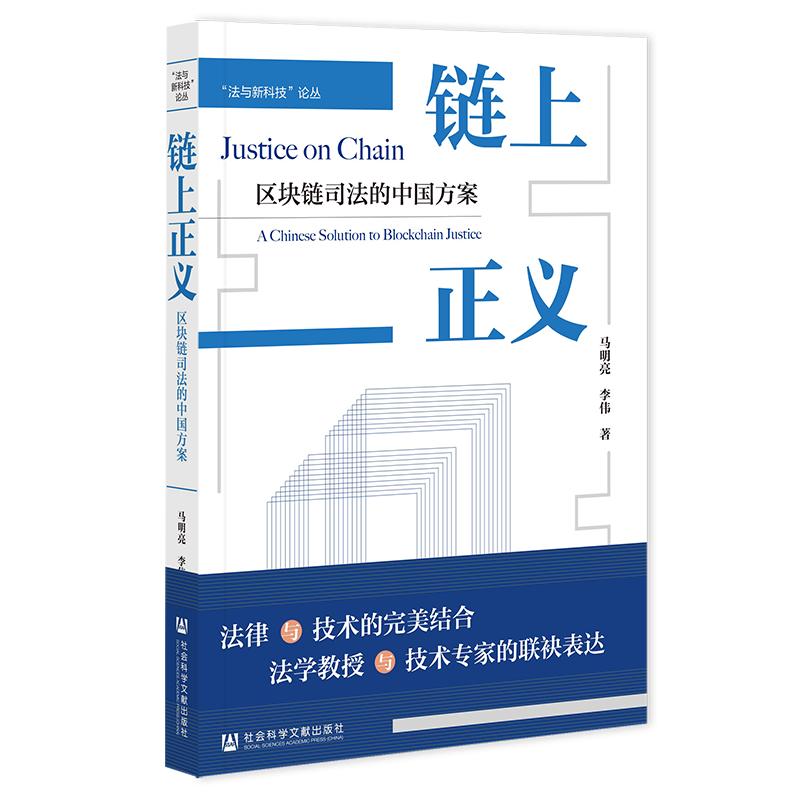
Justice on the Chain: China’s Scheme of Blockchain Justice
By Ma Mingliang Li Wei
Published in October 2023 /79.00 yuan
ISBN 978-7-5228-1813-9
About the author:
Ma Mingliang, doctor of law in Peking University, is currently a professor and doctoral supervisor at the Investigation College of the People’s Public Security University of China, vice president of the Institute of Social Governance and Corporate Compliance, a third-class police superintendent, an expert at the Public Security University Sub-center of the National New Crime Research Center, a member of the Criminal Investigation System Professional Committee of the China Criminal Procedure Law Research Association, and a director of the china law society Police Law Research Association. His research fields are criminal procedure law, evidence law, economic crime investigation, and judicial application of information technologies such as artificial intelligence and blockchain.
Li Wei, PhD, Senior Engineer, School of Computer Science and Technology, Zhejiang University. Member of china computer federation Blockchain Professional Committee, member of National Blockchain and Distributed Accounting Technology Standardization Technical Committee, founder and CEO of Fun Chain Technology. Director of China Young Entrepreneurs Association, executive member of Zhejiang Federation of Industry and Commerce, vice president of Zhejiang Blockchain Technology Application Association, and president of Chongqing Advanced Blockchain Research Institute.
Contents of this book:
The first chapter is the principle of blockchain technology, China policy and legislation.
Chapter 1 Framework and Logic of Blockchain
Main purpose of this chapter
introduction
What is a blockchain?
Second blockchain: a master of various technologies
Third, the technical charm of blockchain: the value of blockchain to data
Four "thousands of people and thousands of faces" blockchain: category analysis
5. Architecture evolution of blockchain: from currency, finance to society
Six Web3.0 era with blockchain as the underlying architecture
Chapter 2 China policy and legislation of blockchain technology.
Main purpose of this chapter
introduction
A pedigree of policy support and legal regulation
Second, the policy of blockchain technology innovation and application
Third, the policy and law of blockchain technical standards
The position, system and path of blockchain technology governance
Chapter 3 Industrial Ecology of Blockchain: Towards "Trust Chain" and "Cooperation Chain"
Main purpose of this chapter
introduction
A pilot application of blooming everywhere: Metauniverse and NFT
Second, the blockchain brings opportunities for the change of supervision methods.
Triple alliance chain and private chain will become the mainstream application direction.
The second chapter explores the application of blockchain technology in the judicial field
Chapter 4 "Blockchain Policing Mode" of Blockchain and Digital Policing
Main purpose of this chapter
introduction
A blockchain investigation platform involving virtual currency crimes
Second, the criminal justice alliance chain with public security organs as nodes
Three inter-departmental and inter-regional police cooperation chains
4. Crime prevention system based on blockchain
Fifth, the prospect of "blockchain policing" in China
Chapter 5 "Blockchain Prosecution Mode" of Blockchain+Digital Prosecution
Main purpose of this chapter
introduction
1. Case-like supervision based on blockchain
Second, digital supervision of non-detainees based on blockchain
3. Community Correction System Based on Blockchain 1
4. Blockchain-based information handling platform for commutation and parole
Application of Blockchain Technology in Public Interest Litigation
Prospect of Six Blockchains Assisting Digital Prosecution
Chapter 6 "Blockchain Court Mode" of Blockchain+Smart Court
Main purpose of this chapter
introduction
A blockchain boosts smart trials: "Let trusted data run more"
Second, blockchain promotes smart litigation services.
Three blockchain boosts smart execution
Four Blockchains Boost the Management of Smart Courts
5. Future Prospect of Blockchain Court
Chapter 7 Blockchain+"Blockchain Rule of Law Mode" of Judicial Administrative Organs
Main purpose of this chapter
introduction
A blockchain-based administrative law enforcement supervision
Second, supervision of penalty execution based on blockchain
Third, notarization based on blockchain
4. Judicial expertise based on blockchain
Fifth, people’s mediation based on blockchain
6. Popularizing Law Based on Blockchain
7. Future prospect
The third chapter is blockchain justice and "chain justice"
Chapter 8 The Rise of Blockchain Justice
Main purpose of this chapter
introduction
The connotation and technical framework of blockchain justice
Second, the germinal logic of blockchain justice
Third, the value of blockchain justice
Chapter 9 "Justice on the Chain": Evaluation System and Challenges
Main purpose of this chapter
Introduction 298
Evaluation criteria and determinants of judicial justice
Second, the historical iteration of procedural justice theory
Third, the evaluation elements of "chain justice": technical, legal and social value elements
Four "justice on the chain" challenges
Chapter 10 Systematic preparation of "chain justice": judicial system reconstruction and technical governance
Main purpose of this chapter
introduction
1. Remodeling of judicial ideas and procedural mechanisms
Second, the top-level design of technical governance of judicial blockchain
Third, the construction of technical standards for judicial blockchain
Fourth, the technical algorithm regulation of judicial blockchain
Fifth, the construction of technical safety evaluation and evaluation system of judicial blockchain
Sixth, the ethical risk norms of judicial blockchain
Conclusion The China Promotion Path of Blockchain Justice
Main purpose of this chapter
Top-level design: development goals and technical roadmap
Second, basic preparation: the compound talent pool of blockchain technology and justice
Third, the promotion strategy and research and development focus
Identify the QR code below
Buy good books on social science literature ~

Reprinted from: Guan Guan
Original title: "New Book |" Chain Justice: China’s Program of Blockchain Justice "