editorial comment/note
Modern industrial system is the material and technical foundation of modern countries and the key symbol of realizing economic modernization. Accelerating the construction of a modern industrial system is one of the priorities put forward in this year’s government work report. Since the beginning of this year, all localities and departments have vigorously promoted the consolidation and extension of advantageous industries, the transformation and upgrading of traditional industries, the cultivation and expansion of emerging industries, and the forward-looking layout of future industries, and the construction of a modern industrial system that is self-controllable, safe, reliable and competitive has made steady progress. From now on, People’s Daily launched a series of reports to tour the new progress and achievements made in the construction of China’s modern industrial system, and to tap the new vitality and new impetus nurtured by China’s high-quality economic development.
In an underground mine in Lu ‘an, Anhui Province, in a roadway hundreds of meters deep, there are no miners with black ash all over their faces, and only large unmanned harvesters are rumbling. The "driver" of the mine car operates remotely with a remote lever in the underground production workshop, which is generally an office building, realizing the transformation of industrial workers from "blue collar" to "white collar".
In Yixing, Jiangsu Province, the sewage treatment plant was transformed into a resource factory, which changed the disadvantages of "high energy consumption, high carbon emission and no resource recovery" in the past. In the whole process of sewage treatment, biogas was generated from sludge to generate electricity, and biogas residue became "fertile soil".
In China Tungsten High-tech jinzhou area Company, a leading precision micro-tool development enterprise in the world market share, the R&D team broke through the traditional process design and initiated a new micro-tool grinding process. In less than two years, they successively successfully developed ultra-fine micro-drills with a diameter of 0.01 mm and extremely small-diameter milling cutters with a diameter of 0.01 mm, which broke the long-term situation that China was controlled by people in this field.
China’s traditional industries are large, accounting for more than 80% of the manufacturing industry. The transformation and upgrading of traditional industries are directly related to the overall situation of modern industrial system construction. In May this year, the first meeting of the 20th Central Financial and Economic Committee emphasized that we should persist in promoting the transformation and upgrading of traditional industries and should not simply quit as "low-end industries".
High-end, intelligent and green development is the general trend of the transformation and upgrading of traditional industries and the inevitable requirement of building a modern industrial system. As the base of modern industrial system, China’s traditional industries are accelerating the pace of transformation and upgrading, and comprehensively enhancing their core competitiveness.
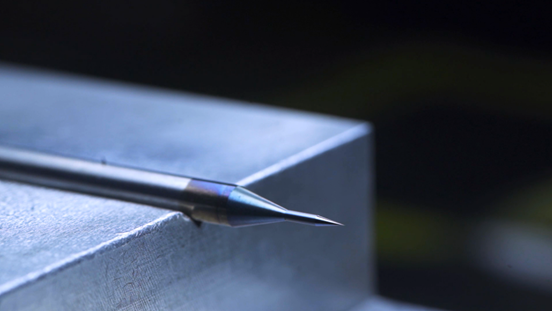
China Minmetals independently developed and manufactured extremely small diameter milling cutter drill needle. Photo courtesy of respondents
Strengthen high-end development and cultivate new kinetic energy of traditional industries
Over the years, China’s textile industry, relying on the profound cultural heritage of China, the advantages of a complete industrial system, and the continuous ability of scientific and technological innovation, has woven a thousand-year splendid history in the needle and thread of history.
In recent years, in order to practice the strategy of manufacturing a strong country and play an important role in building a modern industrial system, the textile industry has persisted in product innovation represented by intelligent textiles and functional textiles, continuously promoted quality improvement and extended application boundaries, and achieved a historic leap.
"As long as you swipe your card here and want to draw out any cylinder of cloth, it will be automatically taken out from the warehouse, all of which are unmanned operations … …” In the printing and dyeing workshop of Yingfeng Technology Company, Keqiao District, Shaoxing City, Zhejiang Province, there is no sewage and no smell, and everything is clean and tidy, which subverts everyone’s impression of the traditional textile printing and dyeing industry.
In recent years, Shaoxing has paid attention to the high-quality development of manufacturing industry through science and technology, and promoted the textile industry to upgrade again. In 2022, Ke Qiao Textile achieved an output value of 129.6 billion yuan, an increase of 7.6%, accounting for 55.8% of the total industrial output value in the district regulations; Textile exports exceeded 100 billion yuan, accounting for 77.7% of the total export of the region.
At present, China textile industry has formed the largest and most complete industrial system in the world, and its manufacturing capacity and international trade scale have been ranked first in the world for a long time, which is an important supporting force for the stable operation of the world textile and garment supply chain.
"Without the modernization of the industrial system, there will be no economic modernization." Fu Wei, an associate researcher at the Institute of Sociology, Chinese Academy of Social Sciences, said that traditional industries should be actively promoted from the low-end to the high-end, and the current situation that the development of traditional industries is not standardized, and the technical content and added value of products need to be improved.
Ding Shiyong, vice chairman of Chongqing CPPCC, believes that under the background of new industrial revolution, the market demand will be more personalized and diversified, and the main path of industrial transformation and upgrading is from low added value to high added value, from high energy consumption and high pollution to low energy consumption and low pollution, and from extensive to intensive.
In recent years, in order to adapt to consumption upgrading, domestic industrial policy adjustment and changes in the international situation, traditional industries have continuously increased their investment, changed their management methods, and promoted their own transformation and upgrading through self-revolution.
According to the data of the Ministry of Industry and Information Technology, China’s industrial structure has been continuously optimized and upgraded. Technologies such as coke dry quenching and sintering waste heat power generation are gradually popularized in the iron and steel industry, and the application level of large-scale equipment such as 10-million-ton oil refining and 1-million-ton ethylene in the petrochemical industry continues to improve. The average single-line scale of the new dry clinker production line in the cement industry has increased to more than 3,605 tons/day, and all new projects in the electrolytic aluminum industry have adopted electrolytic cell technology of more than 400KA, and 45 national advanced manufacturing clusters have been built in the fields of new generation information technology, high-end equipment, new materials and new energy, with the total output value of leading industries reaching 20 trillion yuan.
Highlight the new advantages of intelligent transformation and planting traditional industries
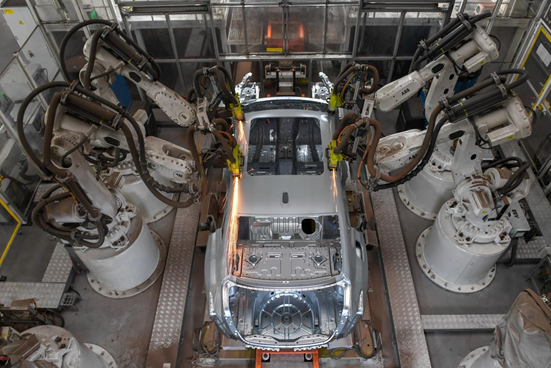
In the welding workshop of FAW Hongqi Prosperity Factory in Changchun, Jilin, robots weld vehicle parts. Xinhua News Agency reporter Zhang Nanshe
"In the homework, please pay attention!" Inside China FAW Hongqi Prosperity Factory, the unmanned logistics car shuttles freely in the workshop like eyes, and when it sees someone in front, it will make such a prompt sound.
In the factory, the automatic feeder, intelligent loading and unloading manipulator and automatic punching machine replaced the manual work and carried out the instructions in an orderly manner, and the staff grasped the working state and completion of the machine in real time.
It is understood that the internal automation rate of Prosperity Factory is relatively high, with 28 robots and 95 unmanned truck assembly lines, which can realize the compatibility of different types of production tasks of oil vehicles, hybrid electric vehicles and new energy vehicles. With the application of digital twin and workshop-level central control computer system, such a huge production plant can realize the complete data acquisition of assembly process and inspection process, detect the working situation of each workshop in real time, locate every detail of the production line, and ensure 100% error prevention of key processes.
"Intelligent manufacturing is not only automatic control, but also means independent analysis and judgment with the support of software. From people looking for data to data looking for people. " Zhang Xiaosheng, deputy general manager of China FAW Engineering and Production Logistics Department, said that the purpose of digital transformation is to improve business efficiency through digitalization. Therefore, digitalization should play a role in improving the efficiency of specific businesses in specific application scenarios and support enterprises to transform into intelligent manufacturing.
It is the general trend to accelerate the intelligent transformation of traditional industries. Only by continuously deepening the intelligent upgrading and filling the shortcomings of industries can we cultivate new industrial advantages and continuously enhance the core competitiveness of enterprises in the new mode of intelligent manufacturing.
"Since the beginning of this year, the demand for transformation and upgrading of manufacturing enterprises has been continuously released, and the intelligent transformation of China’s manufacturing industry has maintained a good development trend, and many innovative highlights have emerged." Tao Qing, spokesperson of the Ministry of Industry and Information Technology and director of the Operation Monitoring Coordination Bureau, said that up to now, nearly 8,000 digital workshops and smart factories have been built in various places, and the digital transformation has basically been completed; 209 companies have explored intelligent upgrading and become international advanced intelligent manufacturing demonstration factories. After the transformation, the product development cycle of these demonstration factories was shortened by 20.7% on average, the production efficiency was increased by 34.8% on average, the defective product rate was reduced by 27.4% on average, and the carbon emission was reduced by 21.2% on average.
How to promote the intelligent development of traditional industries? Yao Lei, Institute of Informationization and Software Industry, China Electronic Information Industry Development Research Institute, believes that intellectualization is a complex system engineering, and it is necessary to give full play to the supporting role of the new generation of information technology, carry out all-round, all-chain, systematic transformation and upgrading of traditional industries, build new advantages of intelligent transformation, and fully support the development of new industrialization. Specifically, first, it is necessary to accelerate the pace of industrial intelligent transformation driven by applications; Second, with the support of technology, consolidate the foundation of industrial intelligent development; The third is to stimulate the vitality of industrial intelligent innovation with ecology as the key.
Adhere to the new support of green and low-carbon forging industry competition
As the "crown jewel" of equipment manufacturing industry, heavy gas turbine needs the cross development of many disciplines and theories and multi-engineering fields, which is an important symbol of the progress of national technical level and manufacturing capacity.
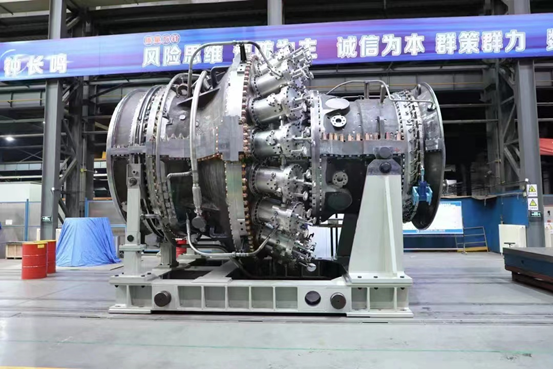
Taihang 110 heavy gas turbine. Photo courtesy of respondents
Taihang 110 heavy-duty gas turbine, as the first heavy-duty gas turbine independently developed and manufactured in China, has been demonstrated and operated in CNOOC Shenzhen Power Plant for more than 10,000 equivalent hours. Compared with thermal power generating units with the same power, it can reduce carbon emissions by more than 1 million tons a year, and the combined cycle can generate more than 150,000 kWh of electricity in one hour, which can meet the electricity demand of 15,000 households in one day.
Gas turbine power generation is a green scheme to replace thermal power generation. Through the effective use of energy, carbon emissions can be greatly reduced and the national double-carbon goal can be helped. Taihang 110 heavy-duty gas turbine is carrying out a full-scale test of low-emission combustion chamber in Shenzhen. At present, it has met the national NOX emission requirement of less than 50ppm, and has made unremitting efforts to realize the new requirements of green, low-carbon and environmental protection energy.
Green manufacturing is the only way for industrial transformation and upgrading, realizing the goal of "double carbon" and the inevitable choice for high-quality development of enterprises. At present, a wave of "green revolution" is on the rise, and more and more traditional industries regard green development as the foundation to enhance their core competitiveness.
The data shows that China’s green and low-carbon industries are booming. The global output of major links in the photovoltaic industry chain accounts for more than 70%, and the production and sales of new energy vehicles have been ranked first in the world for eight consecutive years. In the first half of 2023, the production and sales of new energy vehicles increased by 42.4% and 44.1% respectively, and the supply capacity of green products was significantly enhanced.
Zhao Weidong, director of the Energy Conservation and Environmental Protection Research Institute of China Electronic Information Industry Development Research Institute, pointed out that while making progress, we should also clearly realize that the task of promoting the green development of traditional manufacturing industry is still very heavy.
"We must grasp the key to industrial restructuring. Give full consideration to the comprehensive balance of productivity, energy and resources, pay attention to the matching of productivity distribution in non-ferrous metals, steel and other industries with renewable energy power generation equipment and raw material production areas, and combine ecological environment management with industrial transformation and development. Promote the orderly transfer and undertaking of industries in key areas such as Beijing-Tianjin-Hebei, Yangtze River Economic Belt, Guangdong-Hong Kong-Macao Greater Bay Area and Yellow River Basin, build a number of advanced manufacturing clusters with obvious low-carbon transformation effects, and build an industrial layout conducive to carbon emission reduction. " Zhao Weidong said.
Those who work hard first, those who innovate are strong. Sticking to the chassis, continuously upgrading, and marching steadily along the road of new industrialization, traditional industries will continue to glow with new vitality, lay a solid foundation for building a modern industrial system, and provide strong support for China’s stable and far-reaching economy.