[Looking back at the Thirteenth Five-Year Plan: My Harvest and Transformation] Technological innovation leads China to accelerate its running.
CCTV News:Scientific and technological innovation has never had such a profound impact on China society as it does today.
"Chang ‘e" and "Jade Rabbit" went to Guanghan, "Tianwen-1" visited Mars, the Beijing-Zhangjia high-speed railway went at full speed, the Hong Kong-Zhuhai-Macao Bridge extended in all directions, "Five-hundred-meter Aperture Spherical Radio Telescope (FAST)" paid attention to the universe, and "Dragon" and "Sea Fight" dived into the sea … … With the dream of "dare to go to the moon for nine days and dare to go to the five oceans to catch turtles" come true, everyone’s life has quietly changed in subtle places.
During the "Thirteenth Five-Year Plan" period, the power of China’s scientific and technological innovation surged in generate, and the wave of innovation and entrepreneurship swept across the country, driving the socio-economic life to accelerate towards the future.
Challenge 0.02 mm
As the world’s top technology product, the "hand-torn steel" of soft stainless steel precision foil with a thickness of 0.02 mm can be called the "crown jewel" of the steel industry, which is widely used in aerospace, the fifth generation mobile communication (5G), petrochemical and other fields. Due to the difficulty of process control, it has been monopolized by a few countries such as Japan and Germany for a long time, and China can only rely on imports for a long time. The total annual import exceeds 10 billion yuan, and it is restricted to import only materials with a thickness of more than 0.03 mm.
"This goal is too high, we can’t stand the toss!" "German experts have been invited to conduct research and development before, and many experiments have been unsuccessful." … … In February 2016, when Wang Tianxiang, the party branch secretary and manager of TISCO Precision Belt Company, who just took office, proposed to do "hand-tearing steel", the company was in an uproar and the opposition was endless.
"Running behind others, no matter how good, is the second child. If you want to do it, do the best."Wang Tianxiang’s determination and sincerity moved him.everybodyThey decided to fight for a common vision. In the next two years, they conquered175 equipment problems and 452 process problems, after more than 710 failures, finally broke through the five core technologies of steel purity, production line technology, control level, high-grade surface accuracy and product performance. Finally,existIn 2018, mass production of "hand-torn steel" will be realized.
Compared with the narrow "hand-torn steel" produced in Japan, Germany and other countries, the 600 mm wide "hand-torn steel" developed by TISCO Precision Belt is a cutting-edge product higher than the industry standard and is popular in the market. "In the past, salespeople were carrying products to find the market." Qu Zhanyou, TISCO’s fine belt sales minister, said, "But this year, the number of orders that actively seek cooperation has doubled, and some application areas are unexpected to us."
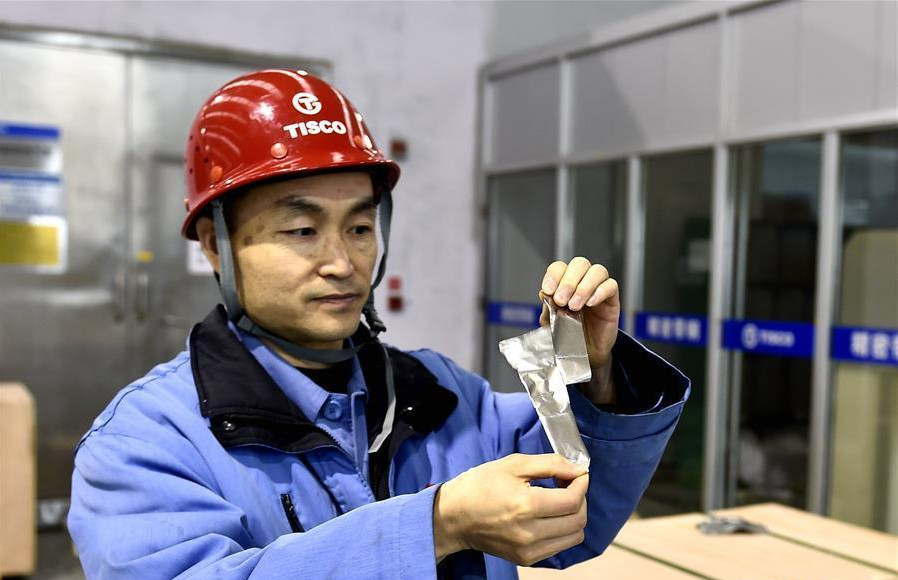
Employees of TISCO Precision Strip Company show "Hand Tearing Steel"
This year, affected by the COVID-19 epidemic, the global industrial chain was hit, but TISCO Stainless Steel Precision Strip Company, which has mastered the core technology, achieved "flying against the trend" by "tearing steel by hand", which not only stabilized the production capacity, but also made new breakthroughs in overseas market expansion. In the first three months of this year, product exports increased by 168% year-on-year.
From the implementation of the national strategy of innovation-driven development, to the "trilogy" of promoting the transformation of scientific and technological achievements, and then to the construction of a national technology transfer system, innovation has been continuously integrated into the overall economic and social development of China.
According to the report of Global Innovation Index, China has become the only middle-income country in the top 25. As China gradually changes from "catching up" to "running together" or even "leading" in the field of innovation, China will bring more surprises to the world.
Witness the changes of railway in the past 100 years
Wang Shuai, known as "Xiao Wang", is the stationmaster of Zhangjiakou passenger transport on Beijing-Zhangjiakou high-speed railway. Wang Fuqiang, known as the "King", is the comprehensive controller of the fire control room in the East Garden North Station of Zhanggao Railway in Beijing. Because the father and son both work in Zhangjiakou Train Depot, everyone affectionately calls them "King Xiao Wang".
If you count Wang Shuai’s grandfather, their family can be said to be three generations of railway people. Born in Zhangjiakou and raised by the railway, the family’s work and life are inseparable from the new and old Beijing-Zhangjiakou railway line.
At that time, Grandpa Wang Shuai was still in the era of steam locomotives. The distance from Zhangjiakou to Beijing was less than 200 kilometers, and a one-way trip took more than seven hours.
Wang Shuai’s father caught up with the internal combustion engine era, and the time for the train to Beijing was shortened from more than 7 hours to 4 hours.
Wang Shuai first worked in Shijingshan Station of Beijing Passenger Transport Section, with three shifts. If you go to work the next night, you have to leave, and even if you take the earliest train in Beijing after work, you have to get home at 14:00 pm. At that time, Wang Shuai thought: Shortening commuting time is the happiest thing. Now the high-speed rail only takes about an hour. "From that time to now, the railway has undergone qualitative changes, from ordinary passengers to high-speed rail, younger and more qualified; From green leather cars to high-speed rail, the supporting facilities are getting more and more perfect. " Wang Shuai said.
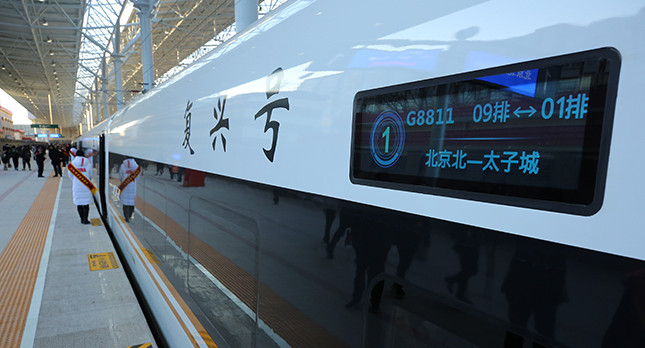
The first train of Fuxing intelligent EMU G8811 on Beijing-Zhangjiakou high-speed railway
With a total length of 174 kilometers, Beijing-Zhangjia high-speed railway is a high-speed railway line with the highest level of intelligence in China. On this century-old railway line, a number of "black technologies" such as Beidou navigation, 5G, and face-brushing pit stop have been applied to the high-speed railway flying at a speed of 350 kilometers per hour. In the 12-kilometer-long Badaling tunnel of Beijing-Zhangjia high-speed railway, the "herringbone slope" and "Fuxing" which originally took 78 minutes to climb over only need a blink of an eye.
China Road, China Car, China Bridge, China Port, China Building … … The development of science and technology makes miraculous projects "dreams may come" and weaves the territory of hope for the people to move towards a better life.
Design the most beautiful "flying arc"
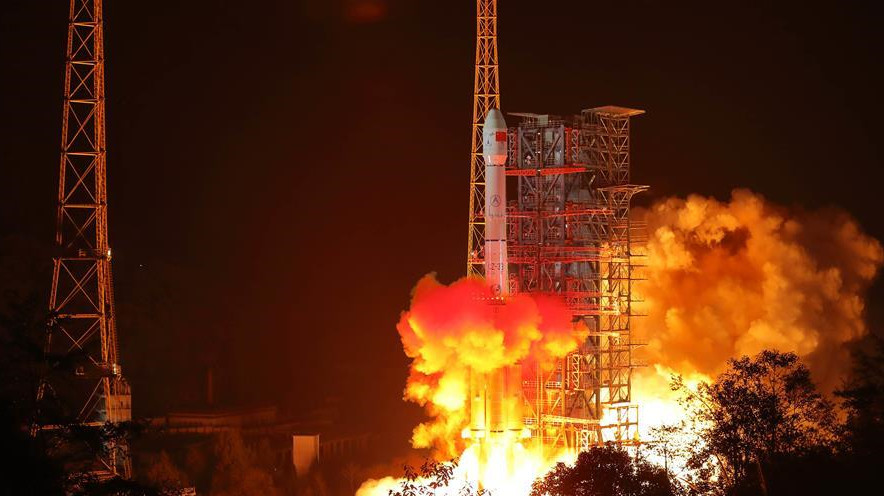
At 2: 23 on December 8, 2018, China successfully launched the Chang ‘e-4 probe with the long march 3b in xichang satellite launch center, which opened a new journey of lunar exploration.
At 2 am on December 8, 2018, Xichang, Sichuan. The Long March 3 rocket carrying the Chang ‘e-4 probe was ignited and lifted off, which opened the first exploration journey of human soft landing on the back of the moon.
More than 2,000 kilometers away in Beijing, after receiving the good news at the first time, Academician Yu Menglun’s hanging heart was finally put down — — Just the day before the launch, the front called to discuss the technical problems related to rocket launch with him, which was finally solved smoothly.
Yu Menglun’s team is Group 1, Room 11, First Academy of Aerospace Science and Technology, which undertakes the trajectory design of launch vehicles from leaving the ground to entering the earth-moon transfer orbit. It is the first high-tech innovation team named after academicians in China.
Generally speaking, trajectory design is to design the flight trajectory for the launch vehicle, including determining the take-off location, launch orientation and flight attitude of the rocket, and determining the altitude, speed and carrying capacity of the flight. This is a flight journey of about 25 minutes.
"It’s like repairing a railway in the sky. The only difference is that the route design of the rocket needs to be smarter." Academician Yu Menglun said.
Over the years, from the Long March II F carrier rocket that sent astronauts into space to long march 3b that sent the Chang ‘e probe into the moon orbit, the trajectory design of many rocket flying missions in China was completed by the "Yu Menglun Team", and they also became the witnesses of China’s exploration of the vast starry sky.
During the "Thirteenth Five-Year Plan" period, China’s space stage has been full of drama. In 2016, a new generation of launch vehicles represented by "Long March 5" and "Long March 7" successfully made their first flight, and the China rocket was upgraded; In 2019, the "Long March 11" was successfully launched at sea, marking that China has become one of the few countries in the world with maritime launch capability; Since this year, the "Long March 5" series of rockets have ushered in a high-density launch. From the first flight of the space station, the first Mars exploration to the launch of the core cabin of the space station, the carrying capacity of large rockets has reached the world-class level.
The ever-increasing space launch capability has made Chinese take a further step in exploring the universe.
(Text/Meng Lizhen Proofreading/Jiang Cheng)