170 starts with marketing calls? Scratch the black card of mobile phone with big data

We know that when we change a new mobile phone number, we can get discounts for new registered users on various websites, such as 20-minus-15 for new take-away users, 30-day free ride for new registered users in bike-sharing, etc., and new registered users of some platforms even cash back directly.
What if there are 10 thousand new mobile phone numbers? In addition to the wool that can be multiplied by 10,000 times the benefit, it can also be used to register various platforms as a water army to brush bills, reputation, powder, reading, etc., which not only takes away a lot of activity funds for new user activity merchants, but also greatly reduces the effect of the activity, and also affects the ecology of the whole Internet.

"Cat pond used to raise black cards for mobile phones in large quantities"
For example, as early as December 2016, 21st century business herald once reported that a group of mobile phones blacked out bonus hunter for China Mobile’s love traffic platform activity, and 82,000 g of traffic was stolen in one month, resulting in a loss of more than 4 million yuan. [1]
For example, in September, 2019, the Economic Information Daily reported that the police in Yunnan traced a marriage fraud case and cracked a black and gray industrial chain consisting of "mobile phone card vendors-number theft dens-code receiving platform-online account dealers-downstream crimes", and collected more than 30,000 mobile phone cards for online fraud. [2]
This is the black card of mobile phone. Most of these cards have no real name registration, and they are kept in batches by a device called "cat pool". They are often used to exploit various loopholes to gain profits from various kinds of wool, and sometimes they are suspected of committing crimes.
In addition, some mobile phone black cards take advantage of the psychology that people don’t want to reveal their mobile phone numbers, and build an online code-receiving website to help people receive the verification codes needed for registration and login on various platforms, and make profits through code-receiving fees or website advertising fees.

How did so many mobile phone black cards come from? Which operators and regions have the most mobile phone black cards? Where are these mobile phone black cards used to receive what information?
With the above problems, we have obtained 1503 mobile phone numbers and 79005 SMS verification codes for online code receiving through 20 most common mobile phone code receiving platforms, trying to find out this black card of mobile phone that is flickering in our sight.
1. What does the black card number of a mobile phone usually start with?
In his years of being harassed by fraudulent phone calls, Alfred summed up a rule: most calls starting with 170 are marketing calls or fraudulent calls. The reason is that the mobile phone numbers starting with 170 are all from virtual operator, and the numbers are relatively easy to obtain, and many of them do not need real-name registration.
So what do these black card numbers usually start with? In other words, what is the number segment of the number? We made statistics on the numbers we got back.
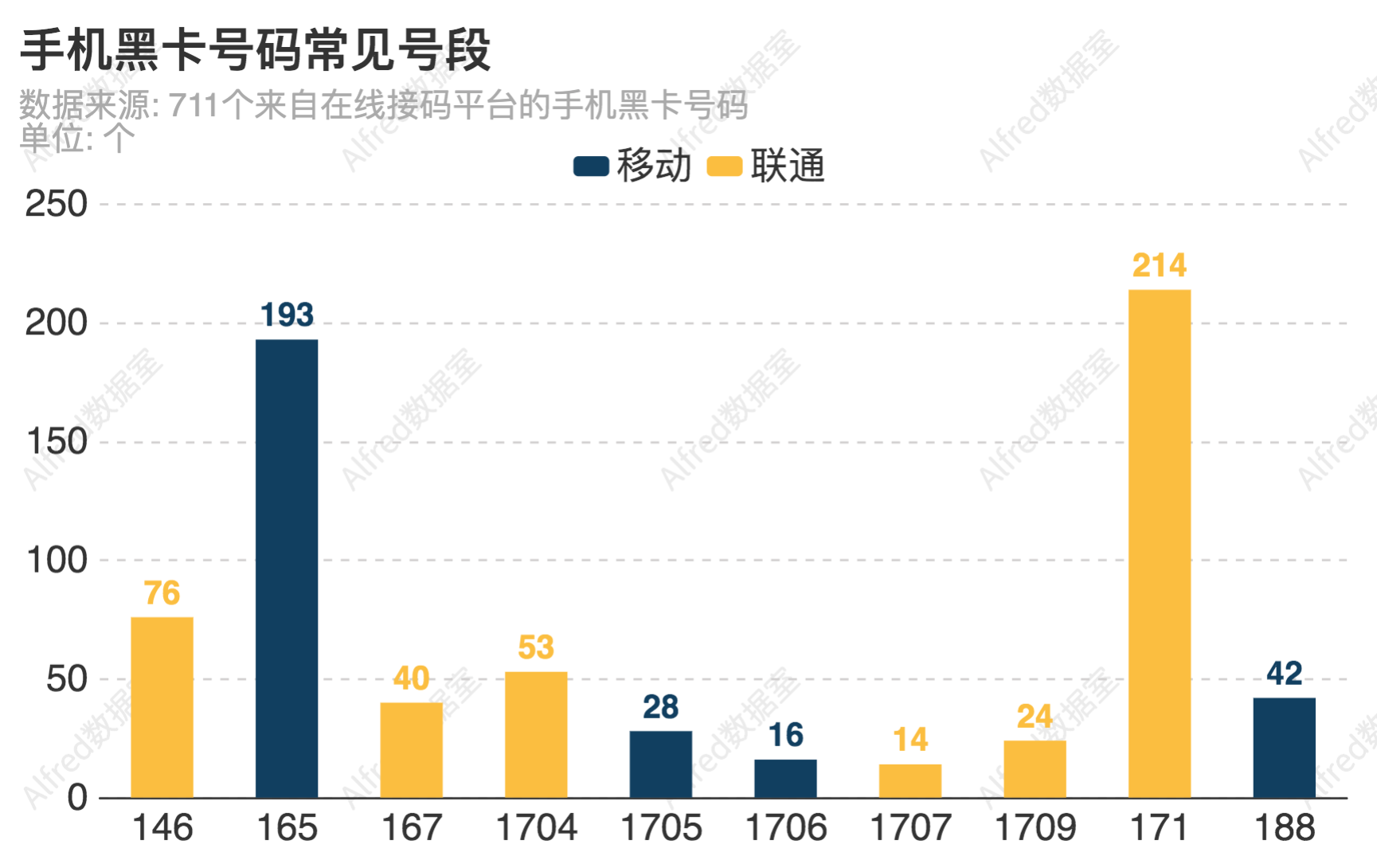
It can be seen that these mobile phone numbers basically belong to the equal-sign segments of 146, 165, 167, 170, 171 and 188, and they are all numbers from China Mobile and China Unicom, and almost none from telecommunications. Except for the number segment of 188 Mobile, the number segment 146 is the number segment of China Unicom’s Internet of Things, and the rest are all virtual operator numbers.
In paragraph 170, there are 1704, 1707 and 1709 belonging to Unicom, 1705 and 1706 belonging to Mobile, but 1700, 1701 and 1702 belonging to Telecom do not appear.
Therefore, it can be considered that these black cards are basically virtual operator cards and Internet of Things cards from China Mobile and China Unicom.
Second, from which virtual operator?
What is virtual operator? Compared with the three traditional operators of China Telecom, China Mobile and China Unicom, virtual operator relies on renting the communication resources of traditional telecom operators to carry out telecom services.

They don’t need to build a large number of communication facilities like traditional operators, but they need to pay high rental fees to traditional operators, so they must develop users on a large scale as soon as possible in the initial stage of operation. According to the data of China Business News, virtual operator has been developing for seven years since the pilot project was opened in May 2013. Although it has handed over 120 million users, it has not become a catfish in the communication industry to stimulate market vitality, but has become the hardest hit area for harassing phone calls, telecom fraud and other user complaints. [3]
So which virtual operator do the above mobile phone black cards come from? We obtained the virtual operator corresponding to each number and made statistics on it.

Among these black mobile phone cards, 48.5% can’t find their specific corresponding virtual operator, and most of these cards are from Unicom. In addition, among the specific virtual operator numbers corresponding to its number segment, the top three virtual operator are Sharing Online, Langma Information and Boyuan Information respectively.
Third, the geographical distribution of mobile phone black cards
We know that no matter whether we use a mobile card or a Unicom card, every mobile phone number has its home. The package fees in different places are different, and the supervision of mobile phone black cards is also different. We have obtained the attribution of each of the above numbers to see where these black cards of mobile phones come from.
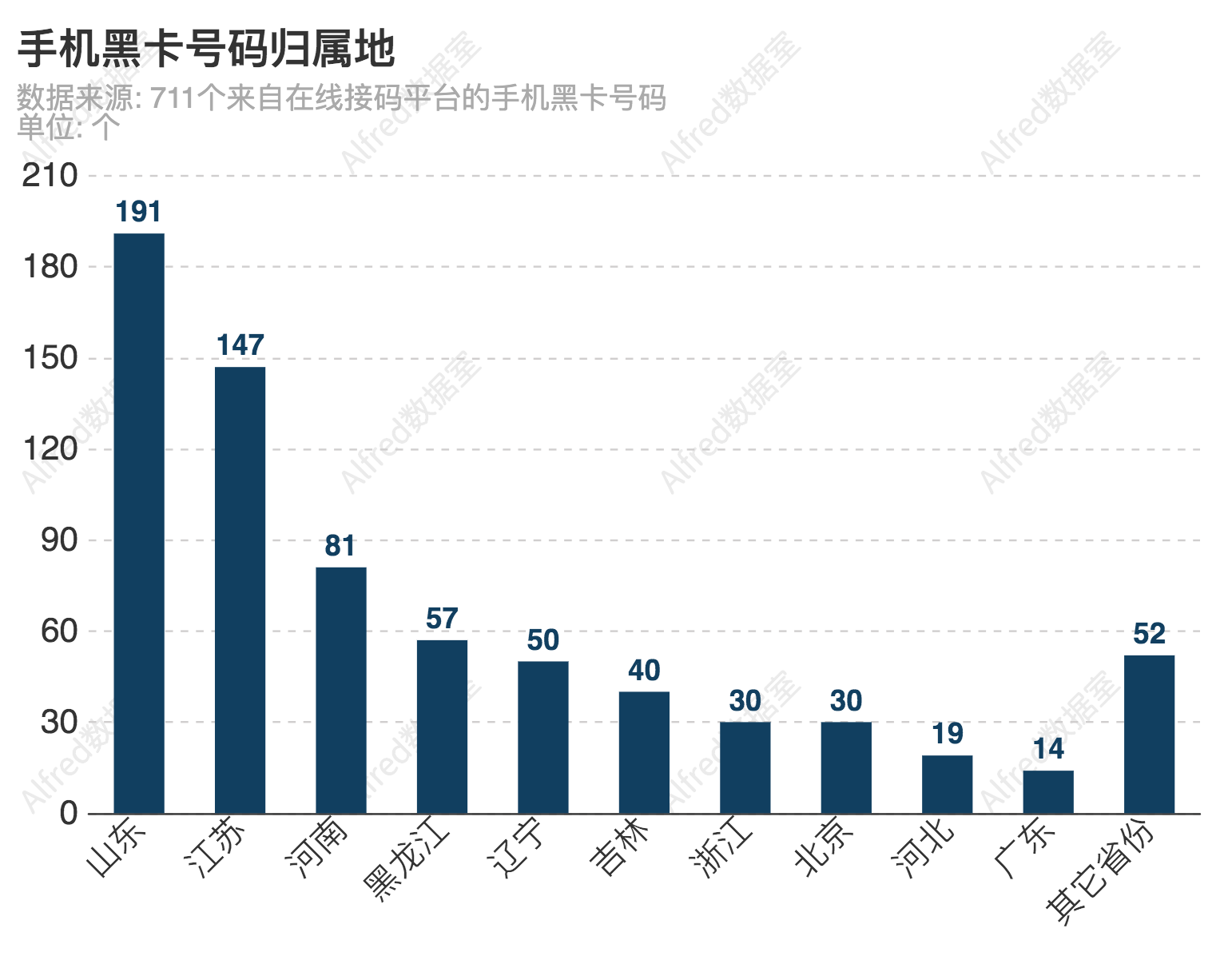
It can be seen that most of these cards come from Shandong, Jiangsu, Henan and other places. Among the top ten provinces, Heilongjiang, Liaoning, Jilin, Zhejiang, Beijing, Hebei and Guangdong are also included. Of course, the situation of different operators is different. We group the numbers according to the operators.
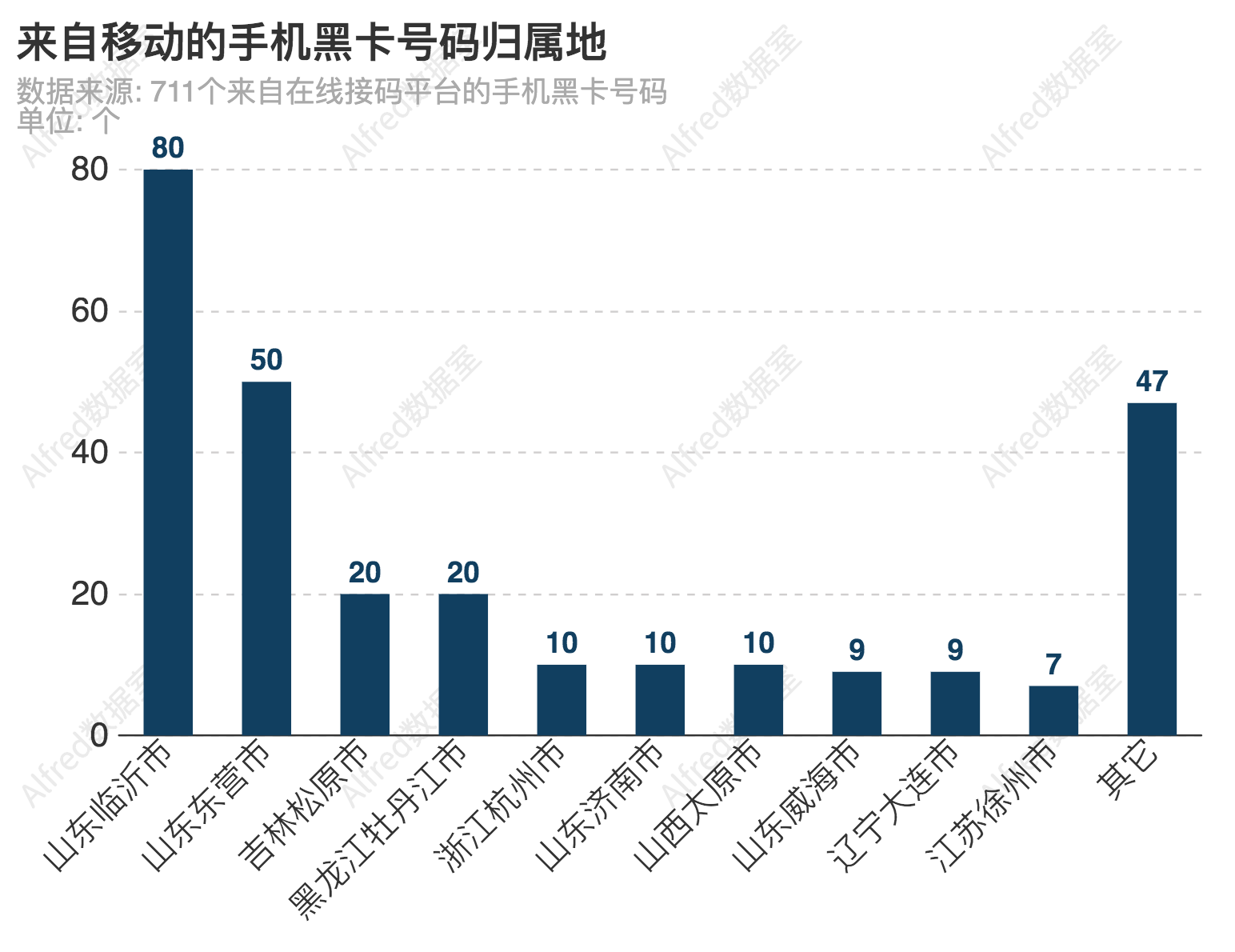
The mobile numbers mainly come from Linyi, Dongying, Jinan and Weihai in Shandong, Songyuan in Jilin and Mudanjiang in Heilongjiang.

Unicom’s number sources are more scattered, mainly from Nanjing and Xuzhou in Jiangsu, Hebi and Jiyuan in Henan and Shenyang in Liaoning.
Fourth, mobile phone black cards from other places
As the mainland’s supervision of black cards for mobile phones is getting stricter and heavier, the industrial chain behind many black cards has turned its attention to mobile phone cards in Hong Kong, Macao and Taiwan and many countries abroad. In the above 20 code receiving platforms, we also obtained 767 mobile phone card numbers from Hong Kong, Macao and Taiwan and many countries abroad.

Most of these black cards are from the United States, Britain, Myanmar and Hong Kong Special Administrative Region. These numbers do not need real-name authentication, and are easy to obtain in batches, and are gradually becoming a substitute for black cards of mainland mobile phones.
Similarly, we analyzed the 20 most frequent mobile phone code-receiving websites, and found in the domain name filing information that 7 websites have servers in the United States, 3 in Panama, and only 3 websites have servers in China. From here, we can also see the importance that this industrial chain attaches to evading supervision.
Five, the platform is online code.
As mentioned above, profiting from online code-receiving websites is a way to realize the black card of mobile phones. We can see which platforms are often used by people to receive the verification code through the SMS verification code information appearing in the online code receiving website, so as to register, log in and bonus hunter.
Therefore, we have obtained 79,005 SMS verification codes from online code receiving websites to see which platforms are online code receiving.

It can be seen that the mobile phone numbers of these online code receiving platforms are often used to receive verification codes of various platforms such as Apple, WeChat, Pinduoduo and Alipay. Among the 79,005 SMS verification codes, there are as many as 7,216 platforms, covering social, e-commerce, internet finance, marriage and love, games, travel, video and other fields.
On the one hand, this means that these areas are plagued by black cards from mobile phones. On the other hand, it means that people are reluctant to use their real numbers to log on to these platforms in order to protect their privacy.
Quote:
[1] Chen Baoliang, Xiao Daming. China Mobile was "robbed" by the "bonus hunter" love traffic of 82,000 g in January. 21st century business herald, 2016-12-14. http://epaper.21jingji.com/html/2016-12/14/content _ 52484.
[2] Li Ziliang, Ji Zhepeng, Wang Yan. Mobile phone "black card" is banned but never stopped. The source of telecom fraud is hard to beat. Economic Information Daily, 2020-03-24. http://www.jjckb.cn/2020-03/24/c_138910147.htm.
[3] Qu Zhongfang, Li Zhenghao. virtual operator these seven years: the business model of relying on wholesale and resale needs to be broken. China Business News, 2020-07-10. http://tech.hexun.com/2020-07-10/201685543.html..
This article was first published on WeChat WeChat official account "Alfred Data Room", please contact the original author for reprinting!